
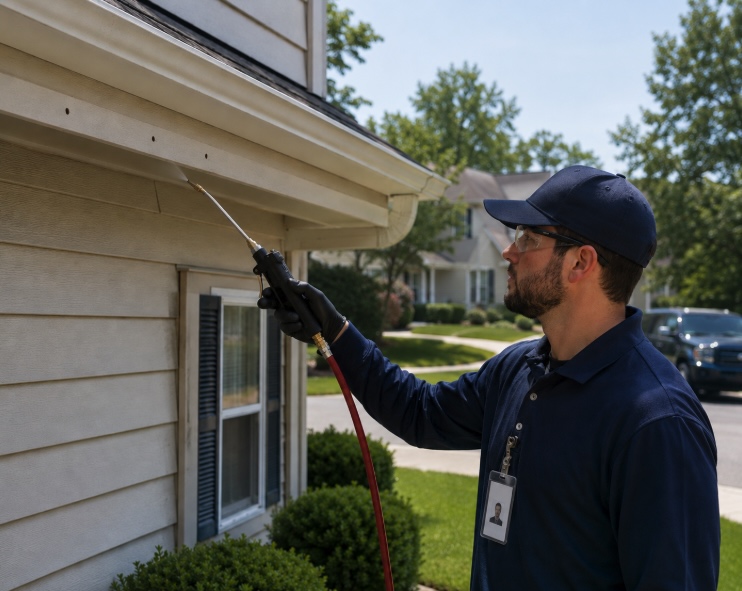
Carpenter Bee Control and Removal Services in New Jersey
Most homeowners notice them in late April or early May. A large, buzzing bee hovers close to the roofline, deck railing, or fascia board. It looks like a bumblebee, but it is not. That bee is a carpenter bee, and it is already working on your wood.
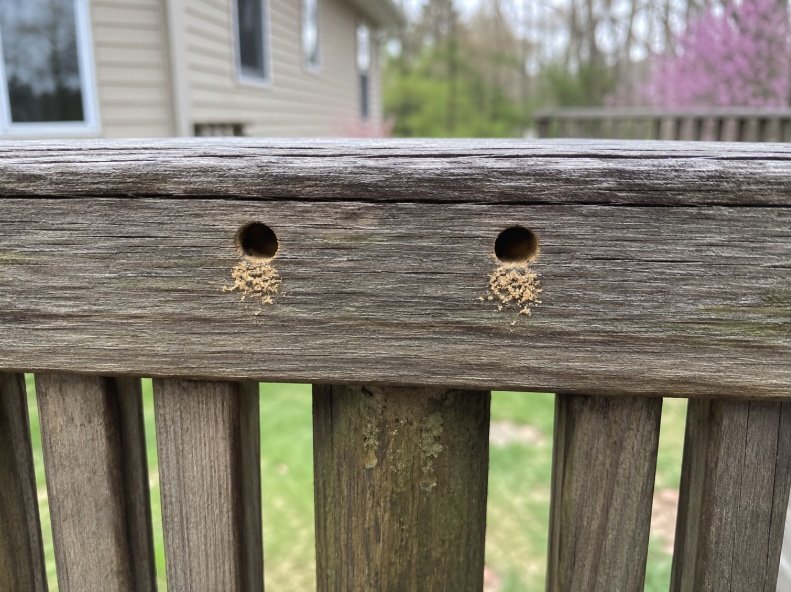
Carpenter bees do not eat wood. Instead, they bore into it to build nesting galleries for their eggs. The entry holes are perfectly round, roughly the size of a dime. Below each hole, small piles of sawdust often appear on decks, windowsills, or porches. Over time, those tunnels extend inward, sometimes reaching several feet in length. Repeated boring across multiple seasons weakens the wood significantly.
The damage compounds in another way, too. Woodpeckers are drawn to the sound of carpenter bee larvae inside the wood. They tear into siding, trim, and fascia boards trying to get at them. What started as a few small holes can turn into a much larger repair job before the summer ends.
Signs of a Carpenter Bee Infestation
Catching an infestation early limits the damage. Look for these indicators around your property:
- Round, smooth holes approximately one-half inch in diameter in wood surfaces
- Sawdust or fine wood shavings directly beneath entry points
- Yellowish staining near holes from bee excrement
- Male bees hovering aggressively near eaves or deck posts in spring
- Woodpecker activity concentrated on one area of siding or trim
Carpenter bees are drawn to unpainted and unfinished wood. Cedar and pine trim, common across older homes in our area, are particularly attractive nesting sites. Deck posts, pergola beams, porch overhangs, and shed siding are among the most frequently targeted surfaces.
Why Carpenter Bees Keep Coming Back
This is one of the most common frustrations homeowners bring to us. Treatment was done last spring. The bees are back again. That pattern is predictable, and it has a specific cause.
Carpenter bees are solitary but territorial. They return to the same nesting sites season after season. New generations emerge from the same tunnels and begin excavating adjacent galleries. Without follow-up treatment and proper wood sealing after the first service, reinfestation is likely. That is why our approach involves multiple treatment stages, not a single visit.
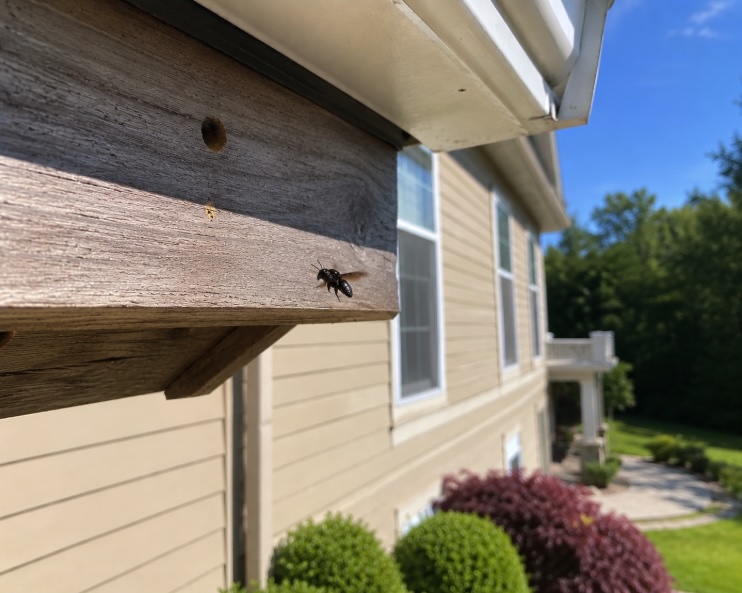
Professional treatment applies residual insecticide directly into each gallery. This eliminates adults and disrupts larval development. Follow-up visits confirm that activity has stopped and address any new entry points that appear. Once bees are gone, sealing holes and treating exposed wood surfaces helps prevent future nesting.
What A customer Says About Our Service
“They come in stages, like they will come a few times to spray the bees and then you call them and then they will come back again if there still are a few lingering around. We went with the annual package. They spray inside and outside carpenter bees, they spray pretty much everything. When we are having trouble with our carpenter bees, we just call them and then they would come out the next day and take care of everything and they follow through making sure that we were satisfied with their work.”
— Jennifer M.
How Callahan’s Treats Carpenter Bees
At Callahan’s Termite and Pest Control, carpenter bee service is structured around the reality that one treatment is rarely enough.
Our process generally follows these stages:
Initial Treatment
A licensed technician inspects the property and identifies all active entry points. Residual insecticide is applied directly into each gallery and along the surface where bees are active. Treatment targets adults on contact and residual product addresses returning bees over time.
Return Visits
Bees that were away from the nest during initial treatment will return. Our service includes follow-up visits to treat any remaining activity. You can also call us between scheduled visits if you are still seeing bees. We come back out and address it, as Jennifer described above.
Annual Protection
For ongoing protection, our annual pest control plan covers carpenter bees along with a wide range of other common pests. Treatments are scheduled in advance, and technicians return at intervals designed to stay ahead of each season’s activity. Learn more about our pest control service agreements.
Carpenter Bee Season in New Jersey
Spring is when activity peaks. Carpenter bees emerge as temperatures climb, typically in April, and begin nesting through May and into early summer. Females are doing the boring work during this period. Males hover and posture near nest sites but do not sting.
By mid-summer, the next generation is developing inside the galleries. In late summer, adult bees emerge and feed before overwintering. The following spring, the cycle repeats at the same locations.
Getting ahead of that cycle matters. Properties treated in late March or early April, before heavy nesting begins, see better results than those treated after significant gallery development. If you are also managing other spring pests, our early-season mosquito control program pairs well with carpenter bee service for full outdoor coverage.
Wood Damage and Repair
Carpenter bees are classified as wood-destroying insects. Over multiple seasons, cumulative gallery damage can compromise the structural integrity of deck posts, beams, and trim boards. If left unaddressed long enough, wood replacement may be necessary.
Callahan’s also provides insect damage repairs for wood-destroying insect activity. If carpenter bees have caused visible structural damage on your property, ask about repair services when you call for treatment. Addressing the damage alongside the infestation prevents the same problem from recurring in already-weakened wood.
Residential and Commercial Carpenter Bee Removal
Carpenter bees are a problem for homeowners and commercial property owners alike. Rental properties, shore homes that sit vacant through winter, older commercial buildings, and wood-sided structures across Ocean, Monmouth, and Middlesex Counties are all common targets.
For businesses, ongoing carpenter bee activity presents both a structural concern and a liability issue. Monthly commercial service plans include inspection and treatment for carpenter bees along with other pests that affect the property year-round.
Schedule Carpenter Bee Service
Callahan’s Termite and Pest Control has been serving central New Jersey since 1991. Our technicians are state-certified, and our service is fully insured and bonded. We have handled carpenter bee problems on wood-sided homes, shore properties, commercial buildings, and everything in between.
Request a free estimate or call 732-899-3030 to schedule an inspection
Frequently Asked Questions About Carpenter Bees
Male carpenter bees hover aggressively but cannot sting. Females can sting but rarely do so unless directly handled. The primary concern with carpenter bees is property damage, not personal injury.
Carpenter bees have a shiny, black abdomen. Bumblebees have yellow markings covering much of the body and a fuzzy appearance overall. If the bee is near a wood surface and there are holes nearby, it is almost certainly a carpenter bee.
Over-the-counter products can kill individual bees on contact. They do not address larvae inside galleries, and they do not prevent reinfestation at sealed holes. Professional treatment uses residual products applied directly into galleries, which is what disrupts the cycle.